

The result will be ever-safer vehicles that can also improve comfort and help contribute to systems that create more efficient traffic control. For example, these systems will be able to warn drivers of environmental hazards such as black ice, approaching emergency vehicles, and the presence of pedestrians and cyclists.
The interconnected systems will also bring benefit. When drivers know an emergency vehicle is approaching, for example, they can clear a path and avoid having first responders stuck in traffic. These capabilities will be particularly important as self-driving systems become commonplace, as entire transportations systems will be able to prioritize and optimize traffic patterns.
Integrating Multiple Systems
Making this future a reality will require tight integration between systems—not only so they can communicate with one another, but also so that their physical dimensions can be kept to a minimum and their performance optimized.
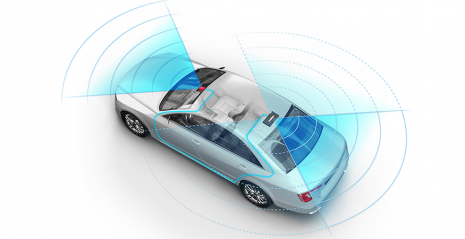
Take V2X signaling as an example. To maintain strong connections, a vehicle is likely to need multiple antennas in different locations. By mounting a primary antenna on the roof and a front antenna under the windshield, for instance, engineers can achieve a 360-degree panoramic coverage around the vehicle.
As with sensor systems, these antennas require high-quality connections to ensure sufficient signal strength and signal integrity. To meet the needs for both high-quality connections and maximum integration, Molex developed a V2X antenna system that uniquely integrates a bidirectional into the front antenna. This smart amplifier balances cable losses and optimizes RF power, helping the system become the first officially certified active 802.11p V2X antenna.
New Sensor Types Emerge
While safety innovation has largely focused on vision, other data types have much to offer. For example, audio signals from roads, surroundings and vehicles themselves can reveal complex layers of information that a camera could never capture.
Cars are already using noise cancellation to detect and reduce these sounds for a more comfortable ride. Could these microphones listen for audible clues to potential hazards?
The answer is yes—and it’s already happening. The latest noise cancellation systems can be used within ADAS/AV technology to augment the current spatial sensors. For example, the microphone function can also be used to identify and triangulate Emergency Vehicles located outside of the field of view of the spatial sensors currently employed by ADAS technology. Greater notice and visibility of emergency vehicles en route allows for advanced precaution action.
These examples are only the beginning of what’s possible. New developments that add big capabilities while also reducing size, mass and power consumption are making it easier than ever to build advanced technologies into vehicles. The future of automobile travel will be more comfortable, and safer, thanks in large part to the ongoing advances in sensors and connectors.
Molex brings its heritage in networking and longstanding reputation for product quality and customer collaboration to meet growing consumer needs across the automotive ecosystem, spanning electrification, Advanced Driver-Assistance Systems (ADAS), automotive high-speed networking, vehicle antenna systems, connected mobility solutions and vehicle-to-everything communications (V2X). With an advanced portfolio of connector and sensor solutions for next generation vehicles, Molex is enabling automotive OEMs to usher in a new era of safer, more enjoyable driving experiences.
